Guides
Family Photo Archive: Recording Place Clues
A family photo archive records place clues by preserving original captions, separating standardized place names, and noting dates, sources, and uncertainty.
What to take away
- Write the inventory for your family photo archive before you buy the boxes. A labeled archive can be corrected; an unlabeled one cannot.
- When documenting family-history place clues, store each birth, move, and workplace as its own dated row.
- Keep the spelling on the photograph and your standardized place name in separate columns, permanently.
- Record what you searched and what survives, so an empty field does not imply that no photographs existed.
- Keep a guess in a notes field, never in the place column.
Record place clues in a family photo archive
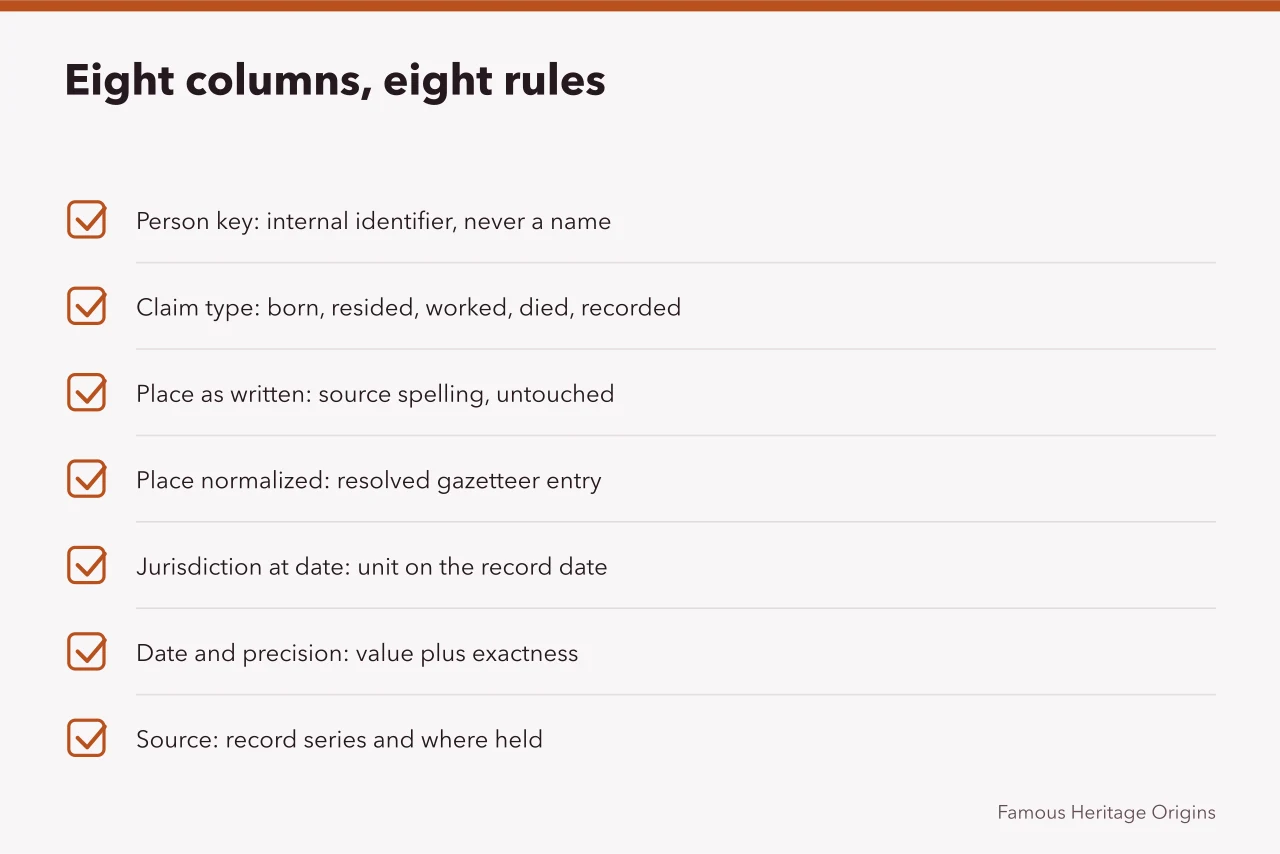
For place research tied to photographs, the eight fields below keep original wording, historical geography, dates, sources, and uncertainty distinct. They are a research inventory rather than a complete description of each photograph. For broader context on how other archives handle this, see family archive case studies.
| Field | Holds | Rule it enforces |
|---|---|---|
| Item key | A number you assign | Keeps two people of the same name apart |
| Record type | Birth, residence, work, death or photograph | Stops five relationships collapsing into one line |
| Place as written | The spelling on the item | Preserves the evidence after standardizing |
| Place standardized | Your resolved place name | Makes searching possible without erasing the original |
| Jurisdiction at the date | The county or state that existed then | Blocks a modern boundary from an old event |
| Date and precision | The value plus how exact it is | Separates "1841" from "about 1841" |
| Source | Who holds the item and its reference | Lets someone else check the row |
| Confidence | Established, probable or unresolved | Keeps a guess from hardening into a fact |
Eight fields take longer than one. They decide whether a relative can add to the archive or only inherit a mystery.
An illustrative filled row
The values below are invented for a hypothetical family and show the format only. They are not a real record.
- Item keyPH-0412
- Record typephotograph, with a residence row for the same household
- Place as written"Hillsboro, Ohio" in pencil on the back
- Place standardizedHillsboro, Highland County, Ohio
- Jurisdiction at the dateHighland County, Ohio, as it stood in the year the photo was taken
- Date and precision"about 1925", precision set to approximate
- Sourcefamily album, held by the eldest daughter; scan file name carries the item key
- Confidenceprobable, because the pencil note and the studio stamp agree on the town but not the year
Why a place has to be an event
A single place column forces a choice the records do not support. Someone born in one county, schooled in a second and working in a third has three true place facts, and each belongs in its own row.
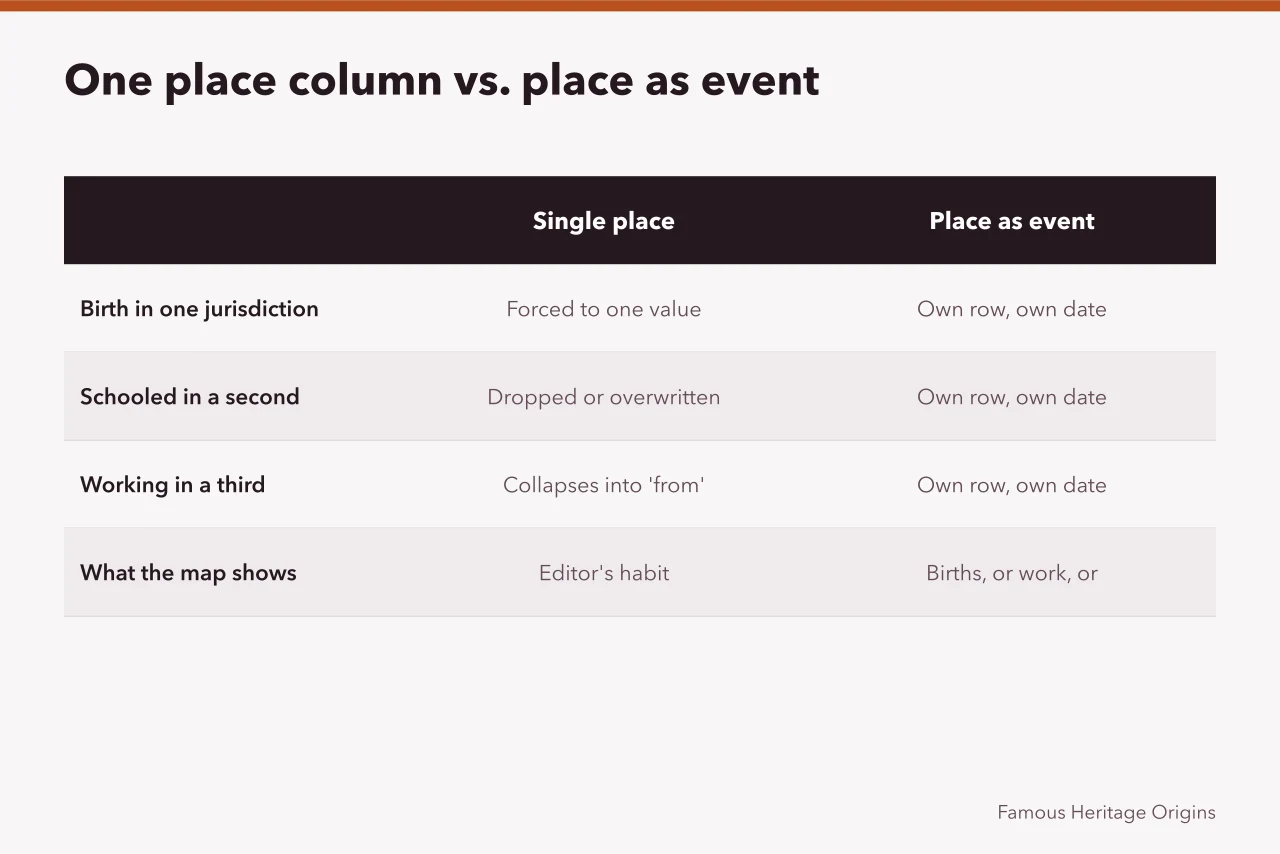
Store each as its own row with its own record type and date range, and the contradiction goes away. If you intend to plot those rows, the former homes map walks through one decision at a time so every pin stays defensible.
A map built from birth rows is a map of births. A map built from one mixed column is a map of whatever you typed.
Keeping the spelling from the back of the photograph
Standardizing a place name is necessary and lossy, so never standardize in place.
- Transcribe the place exactly as written, abbreviations included.
- Add the record type and the date, because boundaries moved.
- For U.S. place names, check the U.S. Geological Survey's Geographic Names Information System (GNIS) for standardized and variant names. For Canadian names, use the Canadian Geographical Names Database. Then compare with a period map or gazetteer before resolving the historical location.
- Put the modern equivalent in its own column and leave the first column alone.
- Give the row a confidence value, and leave it unresolved rather than guessing.
Period maps are often easier to find than the gazetteers that match them. Library of Congress map collections and FamilySearch Places can help you check a county or town as it stood on the date you have.
Dates need the same care. Store "1840s" as written and mark the precision, because a list that pads it to 1845 produces a tidy chart that is fiction.
Dating a place from clues in the photograph
The image itself can narrow the date and the town. A studio imprint on the mount can name a city and sometimes a span of years. Print type, paper stock and the style of dress can help narrow a picture's date, and a street sign or shopfront can support a town identification.
Write each clue in the notes field with what it shows. A clue that narrows the date is evidence; a clue that only feels right is a guess and stays unresolved.
Blank, zero and not searched
Three different facts arrive as one empty space on a card.
- Blank
- nobody has looked, or the item is gone.
- Zero
- you looked and found none in that record series.
- Not searched
- the records exist and you have not been to them yet.
A blank space is easily read as zero, which can record a family as having no photographs for years nobody searched.
Coverage belongs on the card as well, so note which record series you searched and for which years.
Common questions
Can I skip the place-as-written column if my modern place names are good?
No. Normalization is judged against the original, and once the original is gone every correction is a guess.
What confidence value should a guess get?
None. A guess is a research lead, not a claim, so it belongs in a notes field.
How precise should dates be?
As precise as the item and no more. Store the precision separately so "about 1841" cannot quietly become 1841.
Should I write a modern county name into the historical field?
Only in a clearly labeled derived column, never in the field that records what the document says.