Reviews
Part of Why do the same archive mistakes keep happening to careful people?
Archive materials fail quietly: plastics and rubber damage from the inside
Materials that quietly cause the damage: some of the worst things in a family collection are the storage materials themselves, degrading plastics and rubber.
What to take away
- Rubber and plastic degrade continuously and release vapors that damage whatever is stored with them.
- Sticky, chalky, cracked or smelly plastic is a warning, not a cosmetic problem. Separate it.
- Pollutants are often generated inside the box, by the box.
- The fix is usually separation and ventilation rather than a better container.
The problem with plastics and rubber
The Canadian Conservation Institute's note on the care of objects made from rubber and plastic opens with a statement that changes how you store a mixed collection. Natural and synthetic rubber and plastic deteriorate continuously. Controlling the agents of deterioration is the only way to extend their life.
It sets out how that deterioration shows. Rubber may change in strength and flexibility, becoming brittle, hard or cracked, or softening and turning spongy or sticky.
Plastics may lose strength while becoming brittle, cracking and shrinking with age. Surfaces of both may crack, develop chalky or dusty layers, or turn sticky. Colors change either because the polymer molecules themselves alter or because the dyes and pigments deteriorate. Plasticiser, the additive that provides flexibility, may evaporate, or be rejected as the polymer chains crosslink.
The sentence that matters for storage is the one about the neighbors. It notes that vapors harmful to other objects may be released, and that exudations or accretions may appear on the surfaces of plastic and rubber objects.
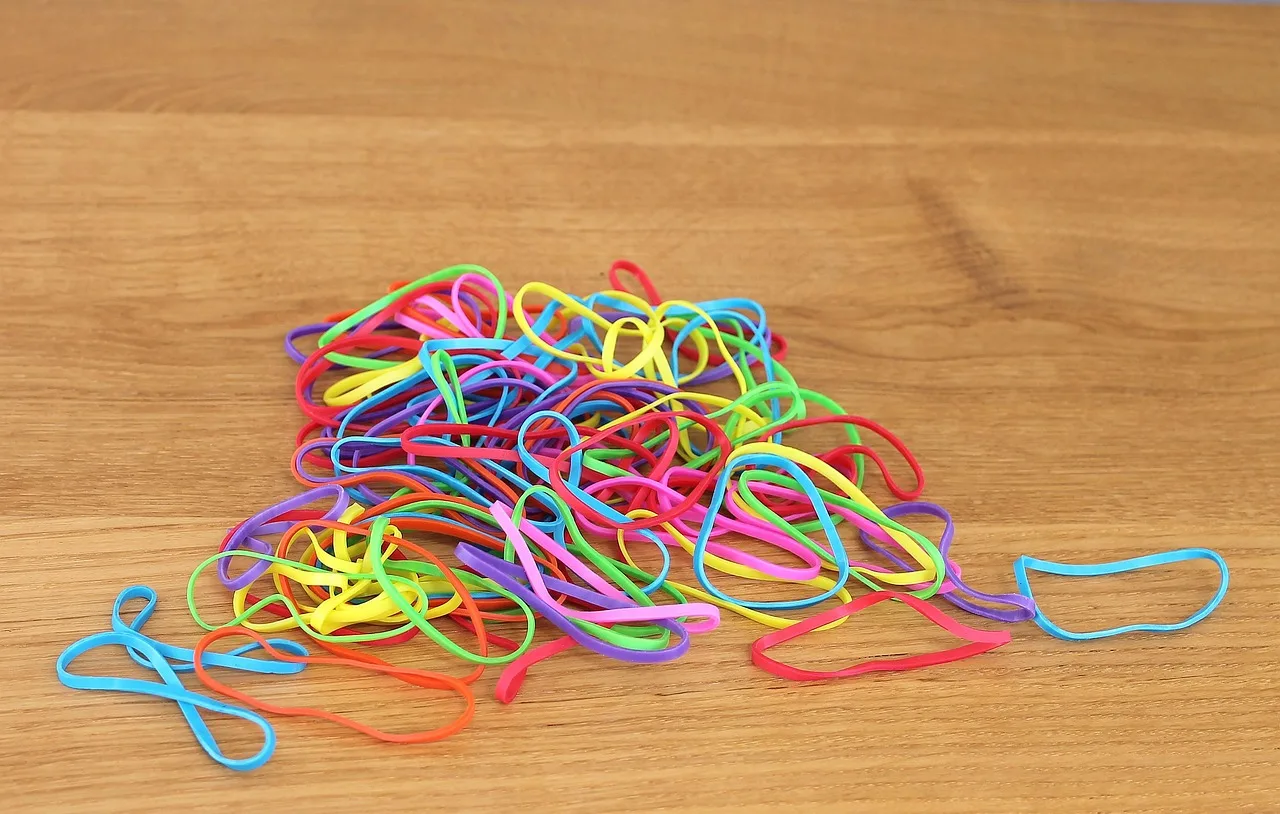
That is why a sticky handbag, a perished elastic band, an old vinyl folder or a degrading toy does not belong in a box with photographs. Its decomposition is being shared.
| Sign | What it means | Action |
|---|---|---|
| Sticky or tacky surface | Plasticiser migrating out | Isolate, ventilate, do not wrap |
| Chalky white bloom | Additive exuding to the surface | Isolate, handle with gloves |
| Vinegar or acrid smell | Acidic decomposition products | Isolate immediately |
| Cracking and shrinkage | Loss of plasticiser | Support and leave alone |
| Yellowing or darkening | Polymer or colorant change | Keep dark, keep cool |
The box as a pollutant source
Pollutants are usually imagined as arriving from outside. Often they are made inside the enclosure. The Canadian Conservation Institute's technical bulletin on pollutants in museums and archives proposes guidelines for controlling them. It identifies common sources and the objects most at risk, and offers actions at several levels to reduce concentrations and reduce the uncertainty in judging risk.
Two of its areas are directly useful at home. It gives detailed attention to filtration at building level, which a house partly achieves by keeping collections away from cooking, heating and traffic. And it covers monitoring, with scenarios ranging from a whole building down to a narrow investigation of what damaged one specific object.
That last idea is the transferable one. When something is staining or corroding and the room seems fine, the source is usually within a few centimeters: the mount, the box, the wrapping, or the object next to it.
The bulletin does not deal with health and safety, which is worth knowing when you read it. That is covered separately, and it matters for degrading plastics.
The inherited enclosure problem
Most of the bad materials in a family collection were not bought by you. They came with the boxes: the vinyl wallet a certificate has lived in since 1978, the self-adhesive album pages, the rubber band around a bundle of letters, the plastic sandwich bag holding a lock of hair.
Treat rehousing as a survey, not a purchase. Go through a box and note what each item sits in. Replace by priority: sticky or smelling items first, then vinyl and rubber, then everything else as budget allows.
Keep the old enclosure if it carries writing, in a separate folder. Then label it as a former housing rather than leaving it with the item.
Choosing by exclusion
For a family collection the material rule is short. Polyester, polypropylene and polyethylene are acceptable. Anything made of vinyl is not. Rubber in any form is not. Old plastic wallets, magnetic album pages and self-adhesive anything are not.
Our guide to what actually damages a home archive covers the wider list of causes, and the notes on reading the labels on supplies cover acid-free and buffered in more detail.