Maintenance
Part of Starting a family archive: count the collection and fix storage before buying anything
Family Archives Mistakes: Tape, Lamination, and Refiling
Family archives mistakes like tape, lamination, and refiling can cause lasting harm. Learn safer alternatives and how to preserve a relative’s original order.
What to take away
- When reviewing family archives mistakes, first ask whether each one is reversible. Damp storage can be fixed next month. Tape cannot.
- Lamination cannot be undone. Encapsulation looks similar, does the same job, and comes apart again.
- Refiling by subject can destroy a relative's original order and obscure provenance. Document the arrangement and keep the originals in that order; add an index instead.
- Most household damage traces back to the room, not the handling. Fix the water before the folders.
The irreversible list
These actions can cause damage no later effort undoes.
- Adhesive tape and glue on originals.Pressure-sensitive tape stains through paper and its carrier degrades into a residue that has to be removed by a conservator, if at all.
- Lamination.It is not reversible by design. Encapsulation between polyester sheets does the same job and can be undone.
- Refiling by subject without documenting the existing order.This can erase a relative's original order and the evidence it holds.
- Trimming to fit.A photograph cut down to fit a frame or a sleeve has lost its border, its studio imprint and sometimes its date. If it is already trimmed, keep it as it is, note any surviving marks, and retain its caption or envelope with it. Do not trim related prints to match.
- Writing on the face or back with ink.Ballpoint indents the emulsion, and marker bleeds through.
- Discarding before the count is done.Duplicates turn out to be different exposures, and blank envelopes turn out to have postmarks.
Refiling can erase family context
A relative's arrangement is more than tidiness. The archival principle of original order is to preserve the arrangement in which records were kept; provenance connects records to the person or family who created or accumulated them and to their context. A photograph filed beside a letter, envelope or caption may carry meaning that subject labels do not capture. If items are moved without recording their arrangement, that evidence may be impossible to reconstruct.
Before moving anything, photograph the box and folder sequence and note the labels and neighboring items. Keep the originals in their existing order whenever possible. If you want to search by subject, create an index or finding aid that points to where the items remain instead of physically refiling them.
Lamination, and the reversible thing people confuse it with
Sealing a fragile document in plastic feels protective. Heat lamination bonds the plastic to the paper and cannot be undone. The reversible alternative is encapsulation. The Canadian Conservation Institute's note on encapsulation describes what it is for: storing and protecting frequently handled paper items such as documents, manuscripts, maps and plans.
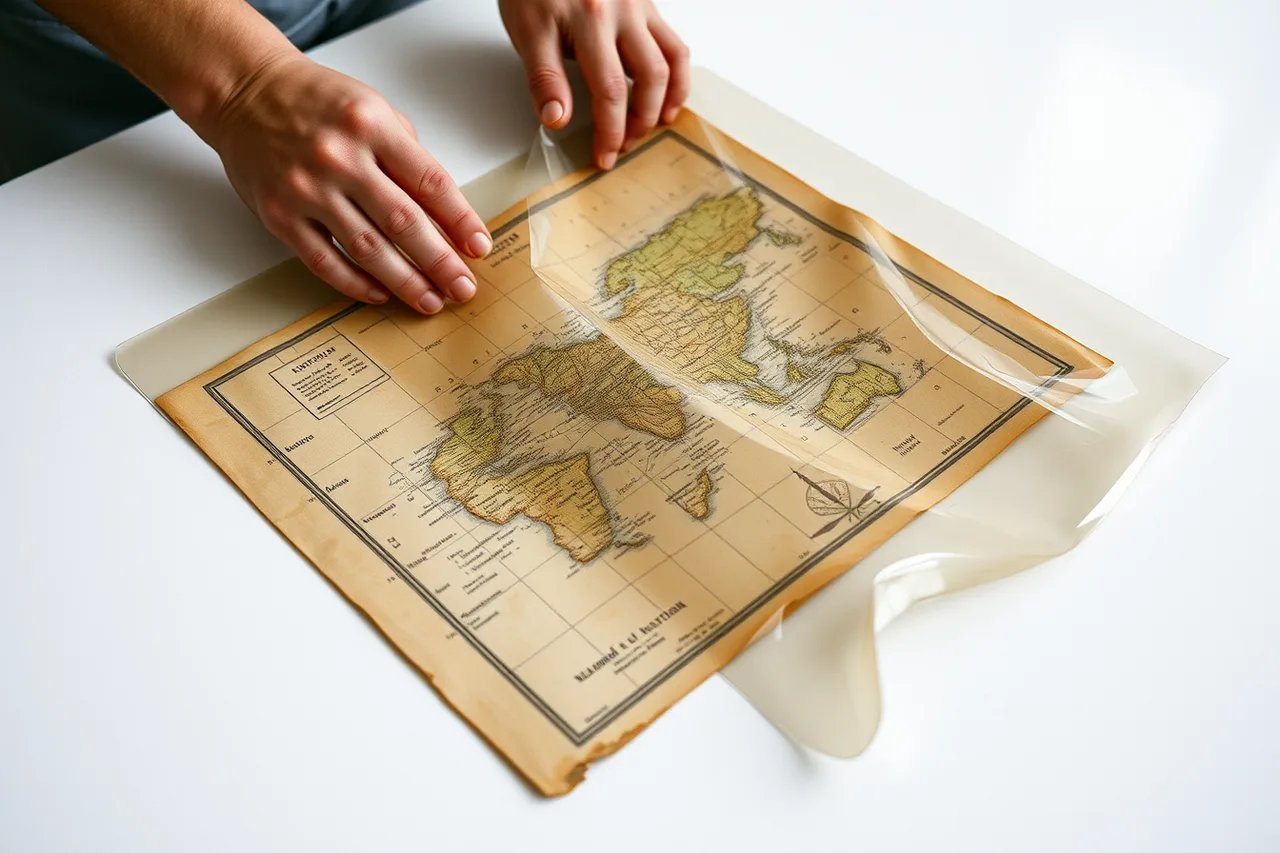
The film lets people handle and view those items while protecting them during display, study and storage. The note states that encapsulation is readily and easily reversible.
It also specifies the material. The polyester film should be free of plasticisers, surface coatings and ultraviolet absorbers, with 3 mil thickness standard for most documents and 7 mil more usual for heavy items such as large maps.
The exclusions matter as much as the method. Polyester film builds an electrostatic charge, so encapsulation is unsuitable for friable media. Charcoal, chalk, pencil and pastel drawings, and gouache transfer onto the film.
Encapsulation is also unsuitable for items attached to a backing board, items that are cockled or warped, and anything with mold or insect infestation.
If you cannot honestly place your document outside all of those categories, put it in a folder instead.
Wet rooms and slow damage
The most common household mistake is not an action at all. It is leaving the collection somewhere that is intermittently damp. The Environmental Protection Agency's page on controlling moisture in your home lists the sources: leaks and seepage, water entering through basement floors, missing gutters, ground sloping toward the house, and moisture generated indoors by showers, cooking and unvented dryers.
It also explains why cold surfaces matter, since air holds less moisture as it cools and condenses on windows and exterior walls.
For an archive, that has three consequences. Do not store against an exterior wall. Do not store below grade without a dehumidifier you actually monitor. Do not store in the room with the dryer.
Mistakes that only cost time
Some errors feel worse than they are. Sleeving in the wrong size, labeling folders in a scheme you later abandon, scanning at a resolution you outgrow, buying boxes that turn out too deep. All of these are annoying and all are fixable. Spend your caution budget on the irreversible list instead.
The starting point guide separates reversible from irreversible work in the first pass, and the notes on reading the labels on supplies cover the enclosures that cause slow damage while looking correct.