Guides
Part of How to sequence a family photograph project from triage to storage
Cupboard versus closet for a small photo archive, ranked by risk
Running a photograph archive without a spare room: choosing the least bad cupboard, monitoring it properly, and using an upright freezer as cold storage.
What to take away
- In a small apartment a photo archive lives in whichever cupboard or closet is least bad. Measurement answers the question, not guesswork.
- A logging thermometer left in place for a month tells you more than any amount of reading about ideal conditions. The Govee H5075 costs about $16 and the SensorPush HT1 about $50.
- When no room is good enough, control a sealed box. That is arithmetic, not a sachet of silica gel.
- Work in sessions with a defined end. A collection spread over a bed at midnight is a collection at risk.
Measure the candidates
Every apartment has two or three possible places: a hall closet, a bedroom wardrobe, under a bed, the top of a fitted wardrobe. A 24 inch reach-in fitted with ClosetMaid ShelfTrack brackets behaves nothing like an airing cupboard built around a hot water cylinder. None of them behave the way you expect.
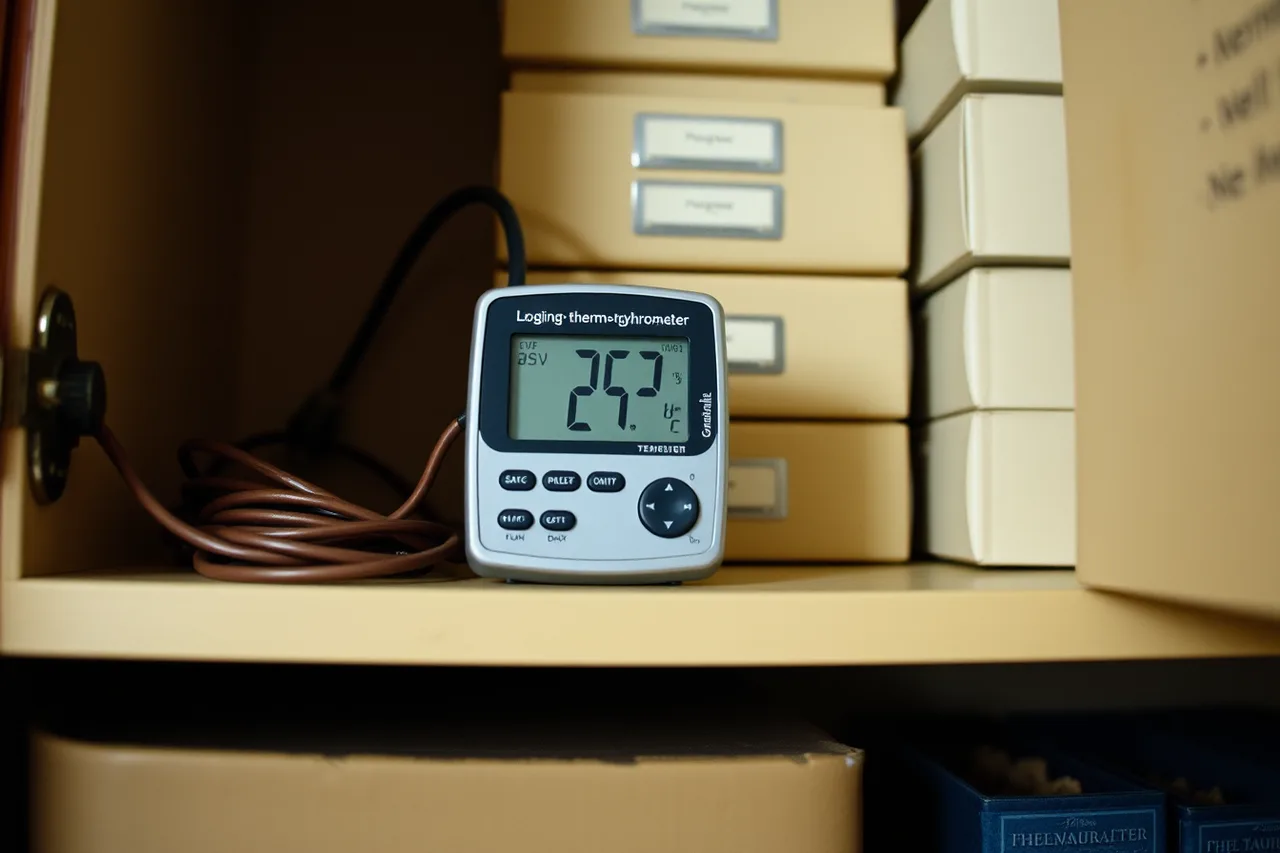
Buy a logging thermometer with a humidity sensor and move it between candidates for a week each. You cannot do this by feel, so you need the instrument. The Canadian Conservation Institute's account of incorrect relative humidity says so.
The Govee H5075 logs to a phone for about $16. The Inkbird IBS-TH2 costs about $20 and the SensorPush HT1 about $50. The Onset HOBO MX1101 is the lab-grade option, typically $130 to $160.
We do not sense relative humidity itself, only the dampness or dryness of our bodies or of objects like paper and cloth. In practice, an instrument must tell us what it is.
It also gives the number that rules a room out. The practical boundary for damp is 75 percent relative humidity, above which mold, rapid corrosion and extreme mechanical damage follow.
Deterioration rates climb steadily as humidity rises, so any reduction below saturation helps. There is no threshold below which a damp cupboard becomes fine.
The target is the smallest swing, not the highest average. A cupboard that sits at 64F all week beats one that runs from 58F to 72F with a lower mean.
Ranking eight real cupboard and closet candidates by risk
| Risk rank | Place | Named example to compare | Typical problem |
|---|---|---|---|
| 1, lowest | Interior hall closet | 24 inch reach-in with ClosetMaid ShelfTrack brackets | Usually the winner. Check for a boiler or riser behind it |
| 2 | Bedroom wardrobe on an interior wall | IKEA PAX frame with Komplement shelves | Good, unless it shares a wall with a bathroom |
| 3 | Under the bed | IRIS USA WeatherPro tote or Sterilite gasket box | Stable but dusty, and vacuumed against weekly |
| 4 | Top of a wardrobe | Top shelf of the same IKEA PAX run | Warmest air in the room, and the hardest to reach |
| 5 | Under-stair cupboard | Staircase cupboard over a concrete slab | Floor level, beside the front door, and often unventilated |
| 6 | Coat closet by the entry | Hall closet shared with jackets and shoes | Wet fabric and outdoor air move through it daily |
| 7 | Kitchen pantry cabinet | IKEA Sektion tall cabinet beside the range | Never. Cooking heat and steam spike twice a day |
| 8, highest | Airing cupboard or bathroom linen closet | Cupboard around a hot water cylinder, or the closet beside a shower | Never. Humidity and heat both spike daily |
Keep boxes off the floor even in a flat. A washing machine hose is the small-home equivalent of a flood plain.
Controlling a sealed box, and the upright freezer as cold storage
A gasketed box does what a cupboard cannot. Compare a Pelican 1450 case, an IRIS USA WeatherPro tote, a Sterilite 20 quart gasket box and a Ziploc WeatherShield bag. All four slow air exchange, and none of them control humidity on its own.
When the room cannot be fixed, the next unit down is the box. Sealed enclosures can be humidity-controlled with a moisture sorbent. The Canadian Conservation Institute's technical bulletin on silica gel and relative humidity is the reference for doing it properly rather than dropping sachets in a tub.
It covers passive control inside enclosures such as display cases, storage cabinets, containers and transport cases. It also provides an equation for working out how much sorbent an enclosure actually needs, based on measured buffering capacity of commercial products such as Art Sorb.
Two of its terms are the ones households get wrong. First, leakage rate: a box that exchanges air needs far more sorbent, and an unsealed box cannot be controlled at all.
Second, conditioning: bring silica gel to the humidity you want before it goes in. Otherwise it drives the enclosure toward whatever state it arrived in. Art Sorb arrives conditioned to about 50 percent relative humidity. Gaylord Archival, Hollinger Metal Edge and University Products sell it in bulk.
For color negatives, slides and inkjet prints, cold storage means a freezer. Archivists commonly cite 40F and 40 percent relative humidity, or colder, for the longest life.
A manual-defrost 7 cu ft upright freezer from Danby or Frigidaire costs about $300 to $400 in most markets. A 21 cu ft version runs about $800 to $1,100. Frost-free models cycle the air and swing humidity, so manual defrost is the safer type.
Bag each box in a vapor-barrier bag with a few grams of conditioned silica gel before it goes in. Let the bag sit sealed until it reaches room temperature, often four to twelve hours, before you open it.
ISO 18920 covers storage of photographic prints and ISO 18911 covers processed film.
It is a real technique with real arithmetic behind it. Treat it as a project, not a purchase.
Sessions, not projects
The practical constraint in a small apartment is not storage. It is working surface. Decide in advance how many folders one session covers, and stop when they are done and back in the box. Nothing stays out overnight.
Our plan for a photograph collection sets the overall sequence, and the notes on work surfaces cover what to sort on when the only table is the one you eat at.