Maintenance
Storing a family archive through a Canadian winter: pick the room
Storing a family archive through a Canadian winter starts with the room, not the box. Compare spare rooms, closets, basements and garages before October.
What to take away
- Storing a family archive through a Canadian winter starts with choosing the room, because the furnace dries every room it heats.
- A spare bedroom over a garage, a closet beside a duct and a shelf above a baseboard heater are the worst spots, since dry heat concentrates in small volumes.
- Keep boxes off the floor, away from exterior walls and out of the direct path of a register.
- An unheated garage, shed or attic is not a room to humidifymove the collection to a conditioned room.
- Measure inside the box as well as in the room, and let buffered boxes do the work that a room cannot.
Why the furnace makes the room the first decision
In a Canadian winter the room matters more than the box, because the furnace dries every room it heats. Winter feels like the safe half of the year, with no sun through the window and no basement damp rising. That is the trap.
The furnace runs for months, and every hour it runs it dries the air in the room where your boxes sit. In January, indoor relative humidity in a heated Canadian house can fall to levels that never occur outdoors in any season.
The mechanism is simple. When cold air is heated, the relative humidity falls, and the Canadian Conservation Institute notes that this leads to low indoor humidity in winter and drives the need for humidifiers. Air that leaks in from outside arrives with almost no moisture, then warms and pulls vapour from anything it touches, including paper.
How the building changes in cold weather
Cold also changes the building itself. Frost heaves shift foundations, and exterior walls get colder than the air inside them. Moisture moves through the wall assembly toward the warm side, which is where your shelf is. A shelf against an exterior wall sits in the path of that movement.
Older Canadian housing stock, common in Halifax, Montreal, Winnipeg and Saskatoon, leaks more air than a tight new build. That sounds like a problem for heating bills, and it is, but it also means faster drying of stored material.
Newer airtight houses have the opposite issue: less air exchange, so moisture from cooking, showers and laundry stays inside and condenses on cold surfaces. Both extremes matter for an archive, and they decide which room in the house is the safer one.
Provincial archives plan their year around this pattern. Library and Archives Canada, the provincial and territorial archives and the Canadian Conservation Institute all publish guidance built for a northern climate, not a temperate one. A small home collection benefits from the same logic, because you are running a one-room institution with a furnace and a window.
Room by room: what each location does to a collection
Compare each candidate room by three things: how close it sits to heat, how close it sits to an exterior wall, and whether it is heated at all. The table sets out what to expect from each location and what to do about it.
| Location | What the heating season does | What to do |
|---|---|---|
| Spare bedroom over a garage | Dry heat concentrates in the small room | Move boxes off the floor and away from exterior walls |
| Closet beside a furnace duct | Dry heat concentrates in a small volume | Keep boxes out of the direct path of a register |
| Shelf above a baseboard heater | Dry heat concentrates near the heat source | Move the boxes at least a metre from the heater |
| A room you can hold steady | Humidity can be kept steady all winter | Make it the home of the archive and let enclosures do the rest |
| Basement | In April, a cold wall can condense the moisture that warm air carries | Do not open boxes there in April and leave them open |
| Unheated garage, shed or attic | Conditions swing with the weather | Move to a conditioned room, or seal in barrier foil and accept limited access |
The best room is not the warmest or the coolest. It is the one whose conditions stay the same from week to week, because a stable cold space is better than a warm room that swings every time a door opens.
The spare room, the closet and the shelf by the heater
A spare bedroom over a garage, a closet beside a furnace duct and a shelf above a baseboard heater are the worst spots in a Canadian house. Dry heat concentrates in small volumes. Watch for humidity signs that show a cupboard is failing before the paper does.
Move boxes off the floor and away from exterior walls. Keep them out of the direct path of a register. A metre of distance from a heat source does more than any gadget you can buy. All three moves cost nothing and can be done in an afternoon.
How the house is heated changes the pattern. If you heat with a wood stove or forced air, expect faster drying near the heat source. If you heat with baseboards, expect stratification: warm at the ceiling, cold at the floor. That is a second reason to get boxes off the floor and to measure at box height.
Paper is a sponge with a memory. It takes on moisture from the air and gives it back, changing size slightly each time. Cellulose fibres swell across the sheet when damp and shrink when dry. The Canadian Conservation Institute is direct about the consequences: incorrect relative humidity causes shrinking, warping, cockling and chemical damage in stored collections.
You can test a room with the paper itself. A sheet that flexed easily in September can crack along a fold in January, especially newsprint, cheap pulp paper and anything that has already aged. If a corner of a document snaps instead of bending, the room is too dry for that item, and handling it now risks a tear that cannot be undone.
Basements, garages, sheds and attics
If the storage space is an unheated garage, a shed or an attic, do not try to humidify it. Move the collection to a conditioned room, or seal it in barrier foil and accept limited access.
Cold storage is not the enemy. Fluctuation is. A stable cold space is better than a warm room that swings every time a door opens, so an unheated space that swings daily is worse than a cool one that stays steady.
Spring brings the reverse risk. Warm air holds more moisture, and a cold basement wall can condense it. Do not open boxes in a damp basement in April and leave them open. How wet Atlantic collections fare in St. John's and Halifax is compared separately.
Moving the boxes into the right room
Moving a collection is also a handling moment. Negatives sleeved in plastic can generate static in dry air, and sliding one out of a tight sleeve draws dust at once. The static problem is covered at length for dry prairie homes.

Handle negatives in a room with the humidity brought back up, or after letting the material rest in a closed box for a few hours. Ground yourself on a metal fixture before you touch anything.
Do not press a curled print flat while it is brittle. Raise the room humidity first, let the print relax over a day or two, then flatten it between boards.
Reading the room: hygrometers and where to put them
You need a number and a way to read it. Paper wants roughly 35 to 50 per cent relative humidity, and photographs want the middle of that band. Without a reading you are guessing, and paper does not respond well to guessing.
Inexpensive digital hygrometers are accurate enough for a home archive if you check them against each other. Buy two, place them in different spots, and see whether they agree. Avoid the cheap dial units sold for greenhouses, which drift and cannot be recalibrated.
A data logger that records overnight is better than a single reading, because the worst drying happens between midnight and six in the morning. Measure inside the box, not just in the room. A closed box buffers the contents, and the gap between room air and box air tells you whether your enclosure is doing its job.
If the room reads 25 per cent and the box reads 38 per cent, your enclosure is working. If both read 25 per cent, you need a different box or a humidifier. Stability beats precision: a collection held at 42 per cent all winter is safer than one swinging between 25 and 60 per cent.
When the room needs moisture
A room humidifier is the simplest fix, but it must be cleaned regularly or it becomes a mould source. Aim for the middle of the target band and stop there.
Do not put a humidifier next to the shelf. Let the room equalize, and keep the unit away from paper. If you cannot control a whole room, control the box.
Enclosures for what the room cannot do
A box is a small climate, so choose it for the climate you cannot control. Buffered board contains an alkaline reserve, usually calcium carbonate, that neutralizes acids as paper ages. In a dry winter room it also acts as a moisture buffer, releasing and absorbing vapour slowly.
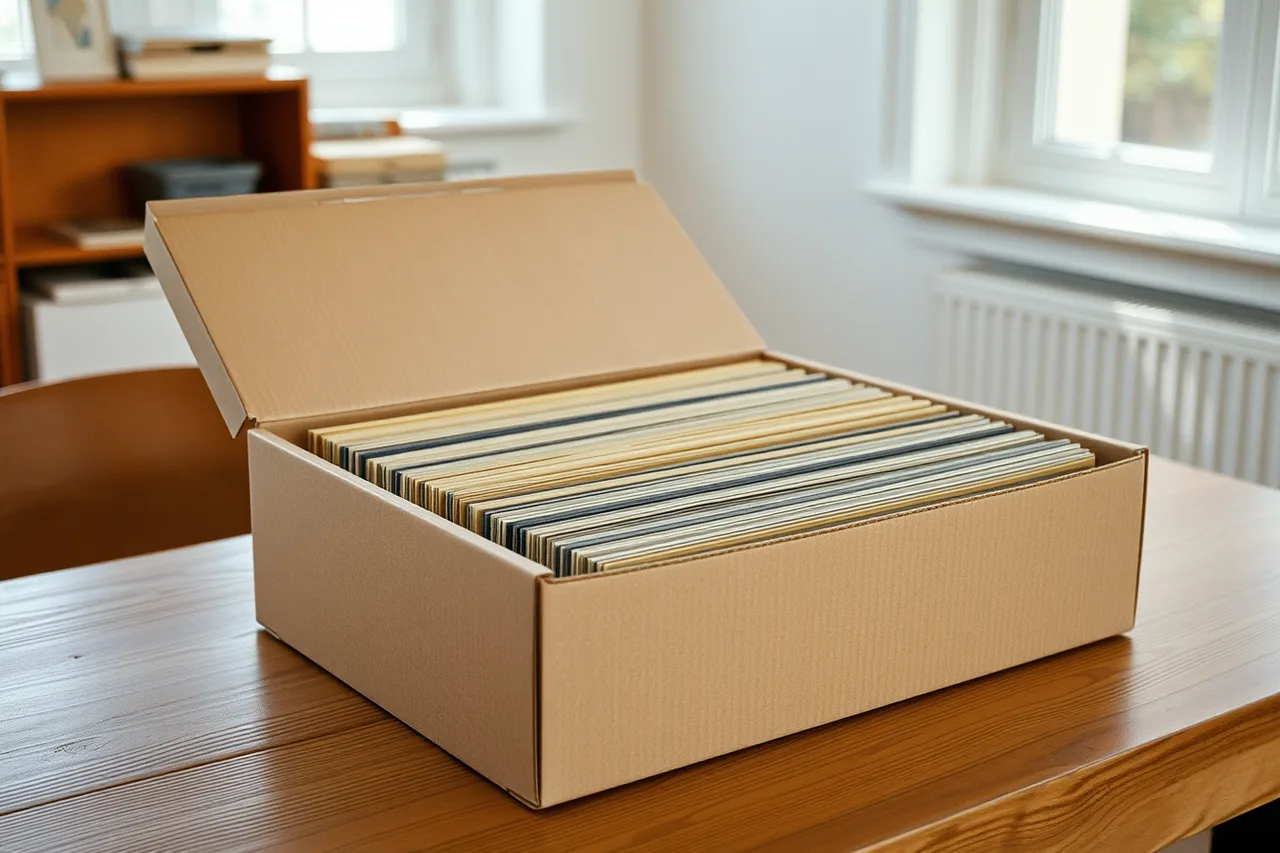
That buffering is why a closed box reads differently from the room. It is not a sealed system, but it slows change, which is what paper needs. Choose boxes that fit the contents without gaps and without pressure, since a box packed tight is harder to buffer than one with a little air around the folders.
Inside the box, use inert sleeves for photographs and negatives, and unbuffered tissue or folder stock for anything alkaline-sensitive, such as colour photographs and blueprints. Interleave brittle items so they do not rub. Knowing what acid-free, buffered, inert means decides whether a sleeve protects a negative or scratches it.
Where a room is genuinely uncontrollable, a barrier enclosure is the next step. The Canadian Conservation Institute's note on low-cost barrier foil states that plastic-laminated aluminum foil is one of the best vapour or gas barriers on the market. It is not for everyday access, so keep it for items you cannot move and cannot monitor weekly.
Suppliers in Ontario, Quebec and British Columbia ship across the country, and Canada Post handles most of it. Watch for customs and duty if you order from the United States, and check currency before comparing prices. Buying in Canada usually means fewer choices and higher shipping, so order in September, before the heating season, rather than in a January cold snap.
The October to April calendar for the chosen room
Think of the year in two transitions. October is when the heating season starts. April is when it ends and the spring damp arrives. Five steps cover both.
Seasonal adjustments
- In early October, record baseline readings in the room and inside each box before the furnace starts running regularly.
- Seal gaps around windows and doors near the storage area, and check that boxes are not sitting against an exterior wall.
- Set up humidity monitoring and note the level at which your house settles once heating begins.
- In April, open boxes on a dry day, air material briefly, and re-check for any sign of condensation or musty smell.
- Record what changed over the winter so next October starts from known numbers rather than memory.
Before the furnace takes over, close the envelope. Check weatherstripping, move boxes inward, and put a hygrometer in the room and another in the box you care about most. Run the same list again in January, because the January pass is the one that catches a furnace running harder than expected.
Airing in April should be brief and controlled. Bring material into a room at stable humidity, look it over, and close it again. This is also when you check for insect activity, which resumes as temperatures rise.
The Canadian Conservation Institute's note on closing a museum for the winter is written for institutions, but the logic applies to a spare room: plan the shutdown and the reopening, and do not leave conditions to chance.
A worked example in outline
Take a spare bedroom that holds three generations of photographs, an old ledger and a folder of newsprint clippings. In October the room reads comfortably within the band. By late January it reads far drier, and the clippings begin to crack at the fold.
The ledger and clippings go into a buffered box with interleaving, the photographs go into inert sleeves in the same box, and a hygrometer goes inside. The box reads higher than the room, so the enclosure is working. A small humidifier then brings the room back toward the middle of the band, and nothing is replaced, only adjusted.
What heat and air sealing cost
Holding humidity steady costs money in a Canadian winter. Natural Resources Canada's home energy efficiency guidance is a reasonable starting point for understanding how your house loses heat and air, which is also how it loses moisture.
Insulation and air sealing reduce both your heating bill and the rate at which your archive dries out. The two goals point the same way.
For a collection that mixes formats, the practical answer is one shared condition: pick a room you can hold steady, and let the enclosures handle the rest.