
Features
Part of Displaying keepsakes without wearing them out
Memory display skills split into three separate practice projects
Rolling a flag, framing a sampler, and building a rotation board: three contained projects that teach a single technique each without risking a collection.
What to take away
- One project, one technique. Mixing three new skills in one afternoon is how items get damaged.
- Rolling teaches you why folds are permanent, and it is the easiest of the three to do well.
- Framing a textile teaches the difference between mounting and attaching, which most people conflate.
- The third project involves no handling at all and is the one most likely to still be working in five years.
Project one: roll a flag, a runner or a length of lace
Folded textiles crease along the fold, and creases become breaks. The Canadian Conservation Institute's note on rolled storage for textiles describes a tube as the basis of a space-saving system for flat textiles that can be rolled, handling everything from narrow lace yardage to large heavy carpets.
The tube itself is what makes this a teaching project. The note says the tubes most often used run 5 to 15 cm in diameter. Mailing tubes, paper towel tubes and free tubes from carpet stores are all convenient, and all contain acidic materials that can harm textiles over time.
The preferred alternatives are acid-free card tubes, typically 8 cm in diameter and 90 to 300 cm long, or high-density polyethylene tubes from archival suppliers. Cheaper ABS tubes from building suppliers work if you wash them with detergent and water first to remove oily residues.
It covers support too, because a sagging roll is a textile carrying its own weight again. Use a dowel or metal pipe through the tube for heavy items, brackets in a cupboard, or foam blocks notched with a semi-circle so the roll rests on the tube rather than on the textile.
What this teaches is that most preservation work is preparation, and that the convenient materials are usually the acidic ones.
Project two: frame a sampler or small embroidery
The Canadian Conservation Institute note on conservation framing of embroideries and other flat textiles covers framing flat textiles already mounted on a solid support. Its methods apply to contemporary needlecraft for home display and to museum pieces.
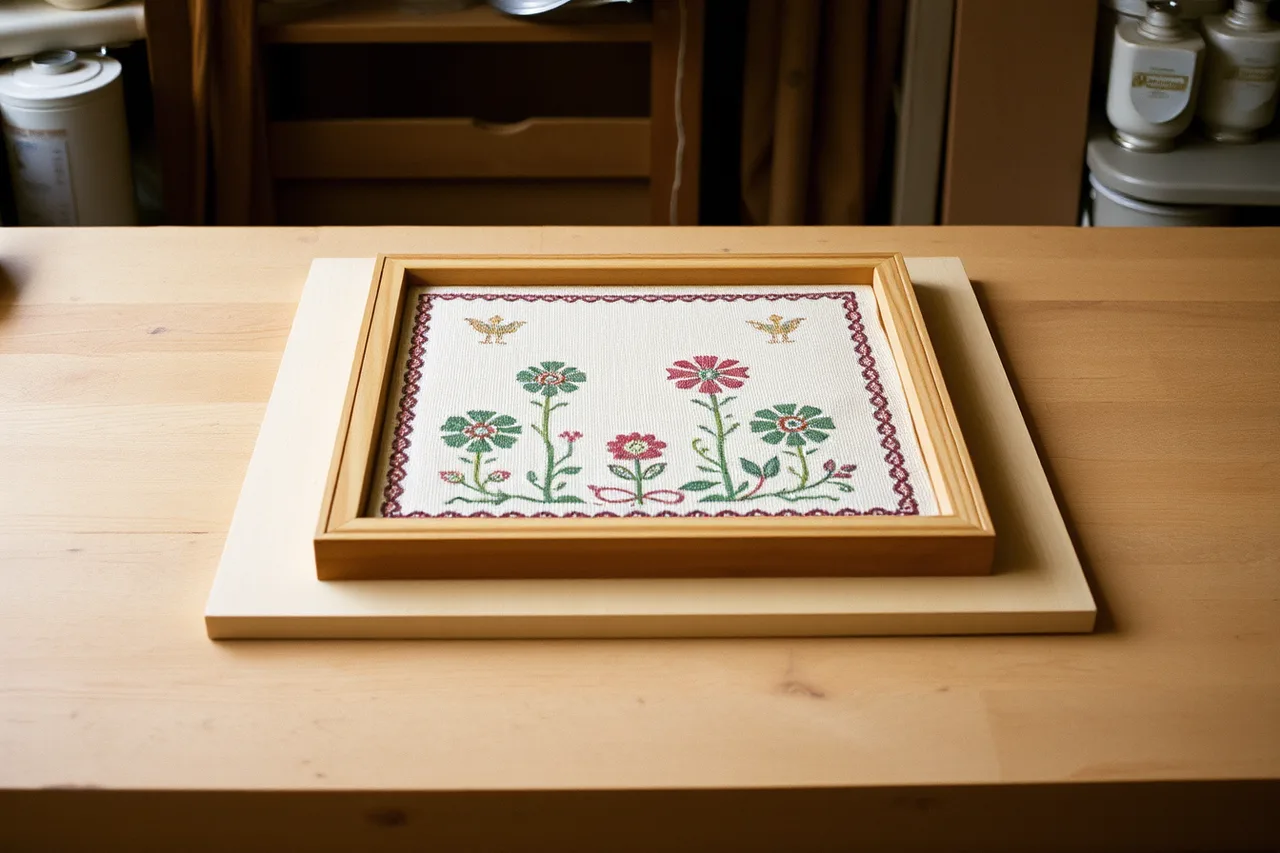
That makes it a good project. You can practice on something you made before touching something you inherited.
It also draws a clear line about when to stop. Most embroideries, lace pieces and even small quilts can be framed safely. But items glued to acidic cards or boards should go to a textile conservator, as should anything with fugitive dyes, mold, insect attack, powdering threads, stains, adhesive residues, splits, tears or losses.
One historical detail explains the whole discipline. Samplers were traditionally attached to a board or stretcher with metal tacks at intervals, and that method left holes.
Project three: build a rotation board
No handling, no tools, and it changes behavior more than the other two.
- Take a sheet of card and rule it into twelve months.
- List what is on display, where, and the date it went up.
- Mark the swap dates for the next two years.
- Pin it inside the cupboard where the off-display pieces live.
Skill it teaches
- Rolling
- Preparation, unbuffered materials, avoiding folds
- Framing a textile
- Mounting versus attaching, when to stop
- Rotation board
- Scheduling, and treating light as a budget
Risk level
- Rolling
- Low
- Framing a textile
- Medium
- Rotation board
- None
Do them in that order.
What none of these teaches
Between them, the three cover preparation, mounting, and scheduling. They do not teach cleaning, repair, or anything involving solvents, adhesive removal, or humidification, and that omission is deliberate.
Those are treatment, and treatment on a family item is a decision to change it. If a piece needs that work, learn how to find a conservator and what to ask, not how to attempt it at the kitchen table.
Our guide to displaying keepsakes without wearing them out covers what belongs on the rotation, and the notes on storing pieces between rotations cover where they go in between.