
Reviews
Part of Displaying keepsakes without wearing them out
4 parts of memory display storage, explained
Storing framed pieces and textiles between rotations: where display items go when they come off the wall, vertical screens for frames, flat storage for textiles.
What to take away
- The 4 parts of memory display storage are upright frame storage, flat textile storage, a home for the framing supplies, and the rotation record.
- Framed work stores upright, on edge, with something between each frame. Stacked flat, the bottom one loses.
- Vertical storage suits only pieces in stable condition. Anything flaking or loose lies flat.
- Textiles want flat storage where space allows, because that removes the stress of holding their own weight.
- Inspect for insects and mold before anything goes into storage, not after.
Part 1: Frames on edge
The Canadian Conservation Institute's storage and display guidelines for paintings start from the principle that storage and display both come down to a secure and stable environment. Then the notes get specific about what goes where.
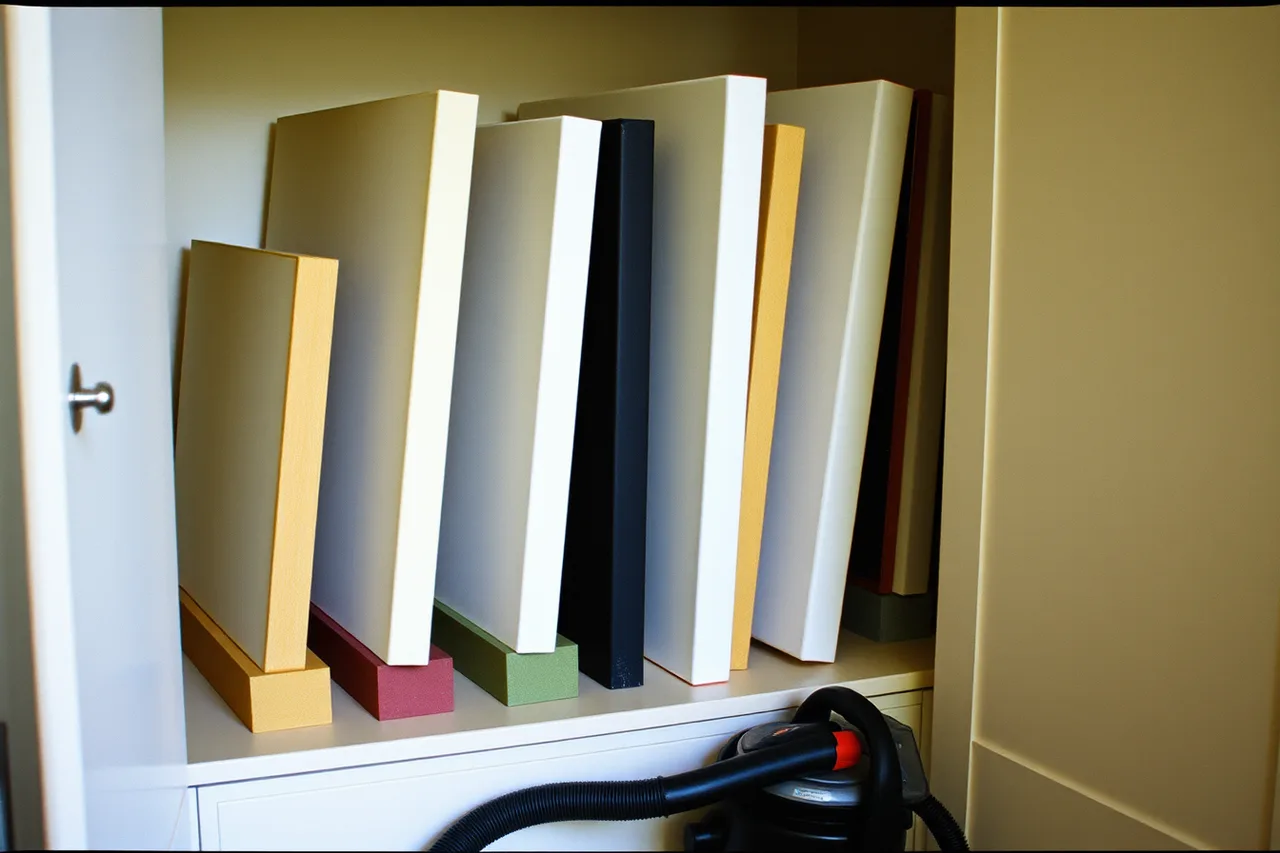
Framed work and work on stretchers or strainers can be stored upright. Unframed paintings on card or panel, with no stretcher behind them, should be stored horizontally in suitable boxes or drawers instead. Canvases not tacked to a stretcher can lie flat on shelving or in drawers. Oversized pieces need specialized storage and professional advice.
The guidance also asks households to do something rare: keep the storage space to itself. A storage room should be dedicated to heritage and art collections.
Non-collection items such as tools, workshop materials, mounts, display shelving and cleaning equipment belong in a separate area. In a house, that means one shelf or one cupboard where the vacuum cleaner does not live.
Without a purpose-built rack, the household version is a shallow dedicated space where frames stand on edge, each separated by a sheet of board, resting on padded blocks rather than directly on the floor. Acid-free board or a corrugated plastic sheet sold as Coroplast both work as the separator.
Never lean a stack of frames against a wall with nothing between them. The wire on one abrades the face of the next.
Part 2: Textiles lie flat
A quilt, christening gown, sampler or uniform is not a framed object and does not store like one. The Canadian Conservation Institute note on flat storage for textiles explains why flat is preferred.
Flat storage supports the whole textile, freeing the fibers from the stress of their own weight. Enclosed, it protects against water, dust and light. Keep folding to a minimum.
Flat storage also takes more space than the alternatives, so it may be reserved for selected pieces. Those include the very fragile, the heavily decorated such as beaded dresses, and garments with weak shoulder seams, stretchy knits or bias cuts.
The preparation step is the one households skip. The note says to examine a textile thoroughly for insect infestation or mold before storage. If either turns up, seal the piece in a clean polyethylene bag and isolate it from everything else.
It also says to remove paper wrappings other than acid-free tissue, particularly colored paper whose dyes can transfer.
Part 3: Storing the framing supplies too
Storing the framing supplies too
| Item | Where it goes |
|---|---|
| Spare matboard | Flat, off the floor, never on end |
| Glazing sheets | Upright, interleaved, edges protected |
| Empty frames | On edge, glass facing consistently one way |
| Corners and tissue | Sealed box, labeled, away from light |
| Cut mats awaiting use | Flat, in a box, sized to fit |
| Acid-free tissue | Flat in a sealed box, away from damp |
| Polyethylene bags | Folded small, for isolating infested pieces only |
Matboard stored on end develops a permanent bow within months. That is a small waste that quietly ruins a stack of expensive board.
Part 4: Keep the rotation record with the storage
A note taped inside the storage cupboard door listing what is on the wall and when it went up is worth more than any labeling scheme. Our guide to displaying keepsakes without wearing them out covers how long a rotation should run.
The single-skill display projects cover a few pieces worth preparing before the next change. Write the date on the note when a piece goes up, and strike it off the day it comes down.