Guides
Part of Displaying keepsakes without wearing them out
Memory display practice for a weekend: reversible paste and mat windows
Weekend spent learning to mount and support: a two-day practice plan done entirely on scrap and copies, cooking a reversible paste, cutting mat windows.
What to take away
- Practice on scrap board and printed copies. Nothing irreplaceable comes out of the box this weekend.
- The adhesive is the decision, not the technique. Most commercial adhesives are unstable and disfigure paper over time.
- Cut mat windows badly six times before cutting one that matters. The sixth is usually acceptable.
- Finish with a support to rest framed work on, which is the cheapest damage prevention on this list.
Saturday morning: the paste
Start with the adhesive, because it decides everything downstream. The Canadian Conservation Institute's note on wheat starch paste is direct about why: many museums use commercially available adhesives to repair and hinge paper, and many of those adhesives are chemically unstable and in time disfigure whatever they touch.
Wheat starch paste is the recommended alternative for paper, covering hinging an item to a mat, repairs, and reattaching leaves in a book.
A good batch is a smooth adhesive that stays tacky even when thinned, then dries to a strong, reliable bond. It has been used for centuries and suits direct, long-term application to paper.
The material matters. It specifies purified, food-grade wheat starch, giving a typical composition of roughly 87 to 91 percent starch, 9 to 13 percent moisture, and under 1 percent fiber, protein and mineral matter.
Cook a small batch, thin it, and make twenty hinges on scrap. Note which consistency behaves.
Saturday afternoon: the window mat
Now cut mats, on scrap board, to standard sizes. Work at 8 by 10 inches and 10 by 12 inches first, since small windows are harder and teach faster.
You are practicing four things:
- A straight cut that does not wander at the corners.
- A window that shows the whole image while still covering its edges.
- Hinges that hold without pulling, so the sheet can expand and contract.
- A fold between the boards that survives being opened fifty times.
Nothing here is delicate work. It is repetition, and it goes wrong in the same three places every time until it stops.
Sunday: supports and the reversal test
Finish with something you will use forever. The Canadian Conservation Institute's note on making padded blocks describes simple blocks with two features: a cushioned surface that protects a frame or the edges of an unframed work from abrasion, and a skid-proof bottom that stops it slipping.
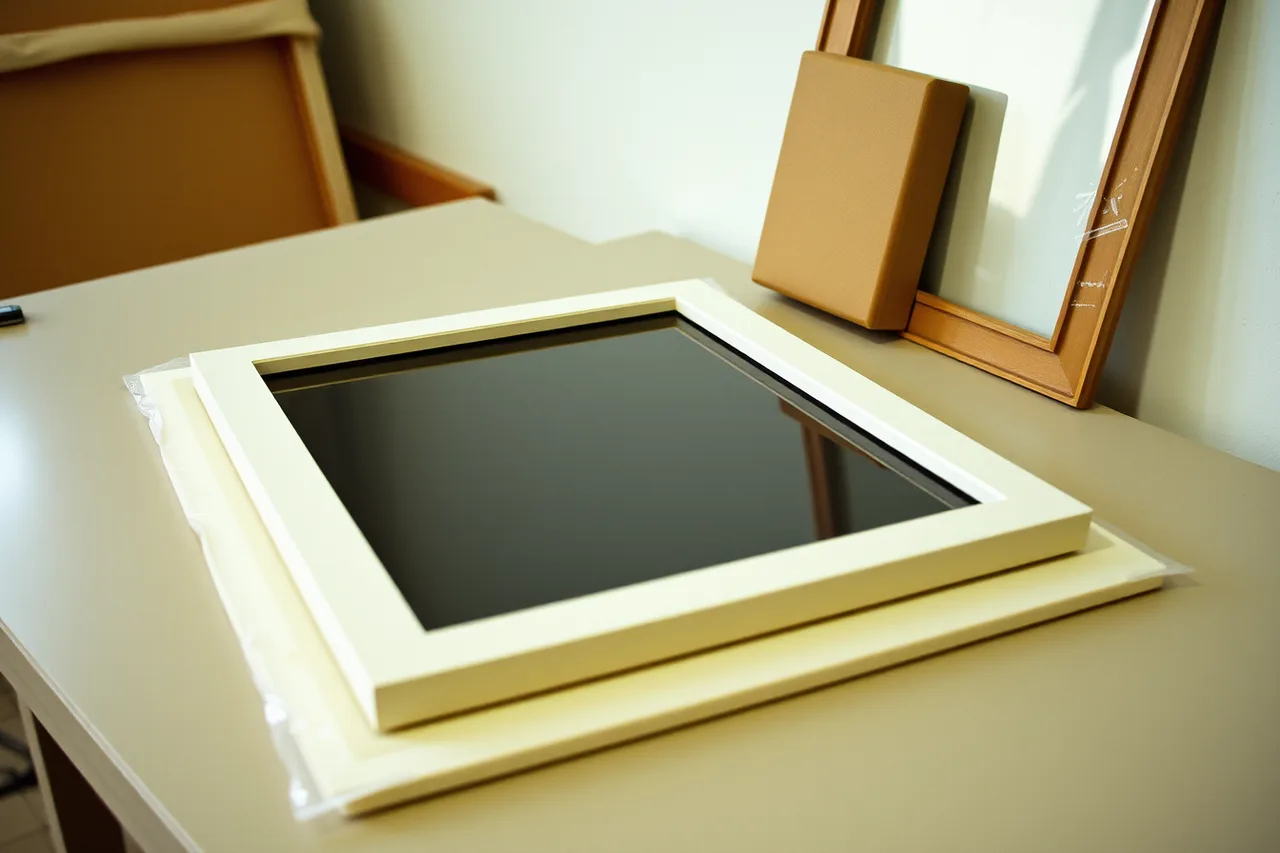
Their uses are exactly the household ones. They support work while an exhibit is being hung or taken down. They raise pieces off the floor in temporary storage, which protects them from flood water. Cut to various lengths and laid on a table, they cushion a painting or frame face up or face down while it is examined.
The note gives three placement rules. Set blocks at 45 degrees to each of the four corners. Sleeve them in plastic so nothing snags and the block stays clean. Pad between the wall and the upper edge of a frame leaned against it.
| Session | Task | Success looks like |
|---|---|---|
| Morning | Cook paste, make hinges on scrap | Tacky when thin, strong when dry |
| Afternoon | Cut six mat windows | Corners meet, edges covered |
| Sunday | Assemble, then take it apart | Everything comes out undamaged |
That last row is the test that matters. If disassembly damages your practice piece, the method is not reversible and should not be used on anything real.
What to buy for the weekend
Scrap 4-ply board, a straight edge, a fresh blade, a cutting mat, purified wheat starch, and half a dozen printed copies at different sizes. Our comparison of glazing, mats and hinges covers what to buy when the practice is over, and the guide to displaying keepsakes without wearing them out covers what should go on the wall at all.